
How Does Rippling Payroll Automation Replace Manual Payroll Processes?
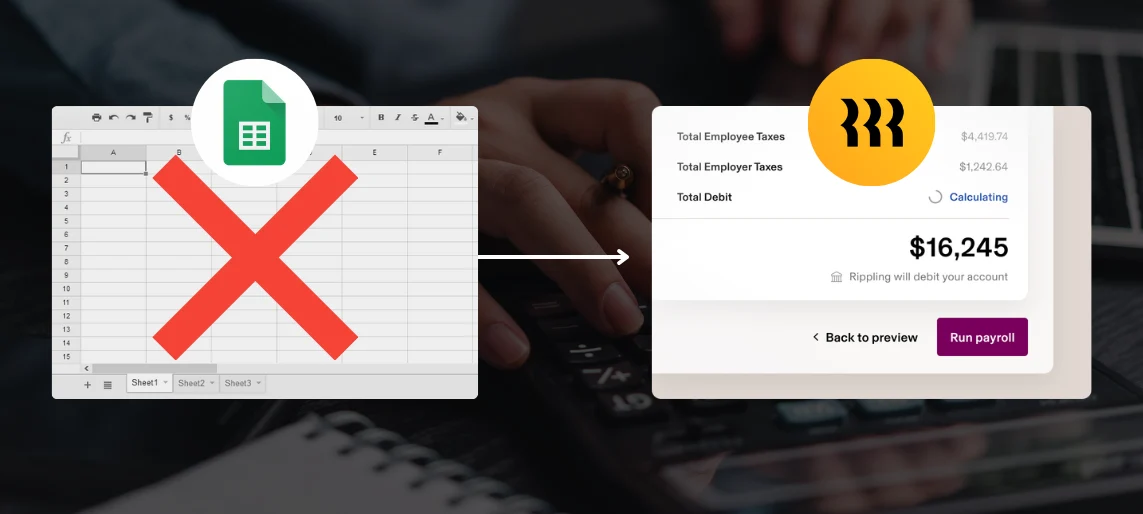
There is nothing wrong with Google Sheets. It is a genuinely useful tool. But somewhere along the way, a lot of growing companies turned it into something it was never designed to be: a payroll system.
If your team is manually entering hours, cross-referencing PTO balances, copying data between tabs, and double-checking formulas before every pay run, you are not just running payroll. You are managing a fragile process that depends on constant attention.
At some point, that approach stops working. This is where Rippling payroll automation changes how the entire process operates.
The Real Cost of Manual Payroll
The most obvious risk is errors. A misplaced decimal or a broken formula can result in incorrect paychecks, and once that happens, the impact is immediate. Payroll mistakes affect trust, not just accounting.
But the bigger issue is how much manual work is required to keep everything running. Payroll data rarely lives in one place. Hours are tracked in one system, benefits deductions in another, and employee updates somewhere else. Someone has to bring all of that together every pay period.
For a small team, that might be manageable. For a company that is scaling, it becomes a recurring operational burden.
There is also compliance to consider. Tax rules change. State requirements vary. Trying to maintain that inside a spreadsheet is not sustainable.
What Payroll Automation Means
Payroll automation is not just about running payroll faster. It is about removing the need to manually move and reconcile data.
In a properly automated system:
- Hours flow directly into payroll
- Employee updates automatically affect compensation and taxes
- Benefits deductions stay in sync
- Tax filings happen without manual intervention
Rippling payroll automation is built around this idea. Instead of treating payroll as a standalone task, it connects payroll to the rest of your workforce data so the system updates itself as changes happen. Payroll automation delivers the greatest value when it operates as one part of a connected workforce system rather than an isolated payroll process.
How Rippling Payroll Automation Works
Rippling is designed around a unified employee record. Every part of the system pulls from that same data source.
That means:
- A new hire automatically appears in payroll
- A compensation change updates pay without re-entry
- A location change adjusts tax settings
- Time tracking feeds directly into pay runs
This is what makes Rippling payroll automation effective. The system is not automating isolated tasks. It is automating how data moves across your organization.
Eliminating Manual Work From Payroll
The biggest shift teams notice is not just speed. It is the removal of manual steps.
With Rippling payroll automation:
- Payroll runs become review and approval, not data assembly
- Tax calculations and filings are handled automatically
- Data does not need to be copied between systems
What used to take hours each pay period becomes a predictable process that requires oversight instead of constant intervention.
Time Tracking That Feeds Payroll Automatically
One of the most common failure points in manual payroll is time tracking.
When hours are tracked outside the payroll system, they have to be exported, reviewed, and entered manually. Every step introduces risk.
Rippling removes that gap. Time tracking is built into the platform, and hours flow directly into payroll. This eliminates the need for manual entry and reduces the chance of missed or incorrect hours.
This is a core part of how Rippling payroll automation reduces errors. It removes the step where errors usually happen. Payroll automation delivers the greatest value when it operates as one part of a connected workforce system rather than an isolated payroll process.
Why Connected Systems Matter for Payroll Automation
Automation only works when systems are connected.
If payroll, HR, and time tracking are separate, automation is limited. Data still has to be moved manually.
Rippling solves this by keeping everything in one system. Hiring, onboarding, payroll, benefits, and time tracking all operate from the same data model.
When a new employee is onboarded, their information flows into payroll automatically. There is no duplicate entry. There is no reconciliation step. That process starts even earlier, when onboarding workflows automatically create payroll records, assign tax documentation, and prepare new employees before their first paycheck.
This is what separates Rippling payroll automation from basic payroll tools. It is not just faster. It is structurally different.
What the Transition Away From Spreadsheets Looks Like
Moving from spreadsheets to an automated system is not just a tool change. It is a process change.
Most teams start by identifying:
- Where payroll data currently lives
- What is being tracked manually
- Where errors or delays tend to happen
From there, the data is mapped into Rippling, and workflows are configured so payroll runs automatically based on real-time data.
Once the system is live, the difference is immediate. Payroll becomes quieter. Fewer issues surface. Teams spend less time troubleshooting and more time reviewing.
Why Setup Still Matters With Automation
Automation does not eliminate the need for a proper setup. It makes it more important.
If payroll is configured incorrectly:
- Errors scale faster
- Incorrect data flows through the system
- Fixes become more complex
Rippling payroll automation works best when the underlying structure is clean. That includes accurate employee data, correct tax setup, and properly configured pay groups.
Getting this right during implementation determines how reliable the system will be long term.
Final Thought: Automation Changes How Payroll Operates
Manual payroll processes depend on people to hold everything together.
Rippling payroll automation replaces that with a system that keeps itself aligned.
When done correctly:
- Data stays consistent
- Payroll runs reliably
- Teams stop spending time on repetitive tasks
The goal is not just to run payroll faster. It is to remove the need for manual coordination entirely.
Build a Payroll System That Runs Without Manual Work
If your team is still relying on spreadsheets or disconnected systems, the issue is not just inefficiency. It is risk.
PARA helps companies implement Rippling payroll automation in a way that works in practice. From data setup to system configuration, we make sure your payroll runs accurately, consistently, and without the manual work your team has been carrying.