
How Does Advanced Payroll & Compliance Configuration in Rippling Support Long-Term Growth?
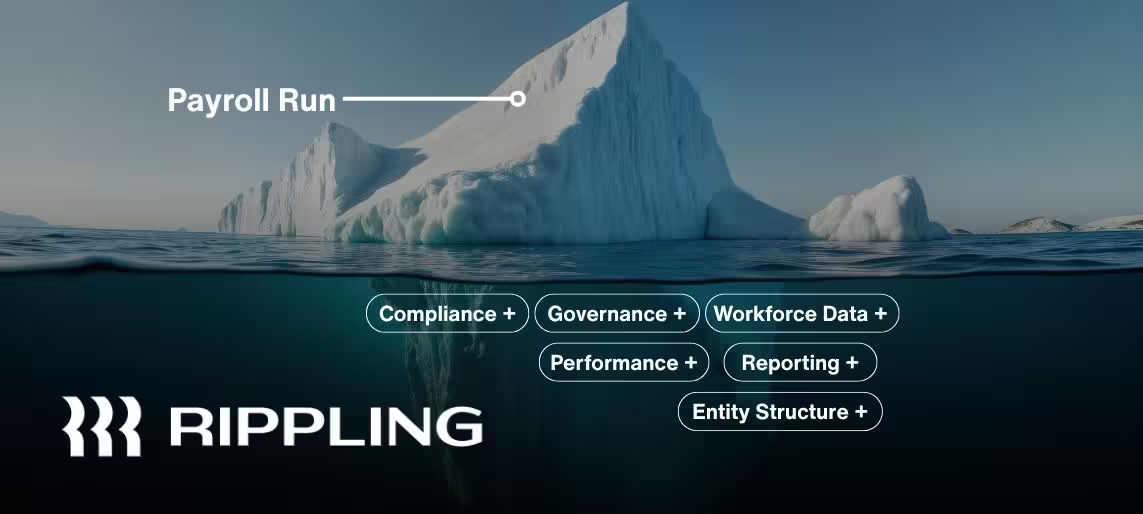
Most payroll systems work when organizations are small.
The real test comes later.
A company expands into new states. Multiple payroll schedules emerge. Additional legal entities are added. Overtime rules become more complex. Employee performance programs influence compensation decisions. Payroll approvals require multiple stakeholders. Compliance obligations increase.
At that point, payroll is no longer just a process.
It becomes infrastructure.
This is where advanced payroll and compliance configuration in Rippling becomes important. The goal is not simply to run payroll. The goal is to build a payroll environment that remains accurate, compliant, and scalable as workforce complexity increases.
Organizations that approach payroll strategically tend to spend less time fixing operational issues and more time supporting growth.
What Is Advanced Payroll & Compliance Configuration in Rippling?
Advanced payroll and compliance configuration refers to the process of designing payroll systems that support workforce growth, regulatory requirements, reporting needs, and operational consistency.
This goes beyond basic payroll setup.
It includes:
- Payroll entity design
- Tax registration management
- Pay group configuration
- Payroll approvals
- Compliance controls
- Workforce governance
- Reporting structure
- Compensation administration
- Employee lifecycle processes
The objective is to ensure payroll remains aligned with the organization's structure as that structure evolves.
Why Payroll Configuration Matters More Than Payroll Processing
Most payroll issues do not happen during payroll runs.
They happen because the payroll environment was configured incorrectly months earlier.
Examples include:
- Employees assigned to the wrong pay group
- Incorrect tax registrations
- Inconsistent overtime rules
- Unclear payroll ownership
- Workforce data inaccuracies
The payroll system is often doing exactly what it was configured to do.
The problem is that the configuration no longer reflects operational reality.
A strong payroll environment starts with thoughtful architecture before the first payroll cycle is ever processed.
How Does Rippling Payroll Setup Create Payroll Stability?
Payroll stability starts with structure.
A Rippling payroll setup establishes the foundation for:
- Payroll schedules
- Tax compliance
- Employee classifications
- Pay groups
- Payroll approvals
- Reporting workflows
Organizations often think of payroll setup as a migration project.
In practice, it is an operational design exercise.
The decisions made during implementation affect payroll accuracy, reporting quality, and compliance long after go-live.
That architecture begins during payroll implementation, where payroll entities, employee classifications, pay groups, and workforce data are configured long before the first payroll is processed. Those foundational decisions determine whether payroll remains stable as the organization grows and are explored in How Does a Rippling Payroll Setup Create Long-Term Payroll Stability?
Why Compliance Depends on More Than Tax Filings
Payroll compliance is often associated with tax calculations and filings.
Those are important, but they are only part of the picture.
Compliance also depends on:
- Employee classification
- Overtime eligibility
- Work location accuracy
- Payroll recordkeeping
- Approval processes
- Compensation governance
As organizations expand into multiple states or entities, compliance requirements become increasingly complex.
The more workforce complexity increases, the more important payroll structure becomes.
Compliance problems rarely begin with filings. They usually begin with configuration.
How Do Payroll Governance and Workforce Governance Connect?
One of the most overlooked aspects of payroll management is governance.
Organizations often focus on payroll calculations while overlooking operational ownership.
Questions such as:
- Who approves payroll?
- Who owns employee data?
- Who manages compensation changes?
- Who validates payroll exceptions?
become increasingly important as organizations grow.
Without governance, payroll accuracy depends on individuals rather than systems.
Strong payroll governance creates consistency by defining ownership, accountability, and review processes across HR, finance, and operations teams.
Why Employee Performance Data Matters for Payroll Planning
Payroll and performance management are often viewed as separate functions.
In reality, they frequently influence one another.
Performance reviews can affect:
- Compensation adjustments
- Bonus eligibility
- Promotion planning
- Workforce development decisions
As organizations grow, leaders need visibility into both workforce performance and workforce costs.
This is where performance management becomes part of a broader workforce governance strategy.
In practice, employee development, compensation planning, promotions, and workforce planning all influence payroll over time. Connecting those processes creates stronger operational governance because employee decisions no longer happen in isolation. That relationship is examined in How Does Rippling Performance Management Connect Employee Growth and Workforce Operations?
How Does Advanced Configuration Support Organizational Growth?
The organizations that experience the fewest payroll disruptions are usually not the ones with the simplest payroll environments.
They are the ones with the strongest operational foundations.
Advanced payroll configuration helps organizations manage:
- Workforce expansion
- Multi-state operations
- Additional entities
- Evolving compensation structures
- Changing compliance requirements
Without structure, payroll complexity grows faster than operational capacity.
With structure, payroll scales alongside the business.
This is one of the primary reasons organizations invest in modern payroll platforms.
The software matters, but the configuration matters more.
Why Data Quality Remains Critical
Payroll automation, reporting, and compliance all depend on accurate workforce data.
Even sophisticated payroll systems struggle when workforce records contain:
- Inaccurate work locations
- Outdated employee information
- Inconsistent classifications
- Incomplete tax records
Automation amplifies both good data and bad data.
Organizations that prioritize workforce data quality during implementation generally experience stronger payroll outcomes later.
Payroll accuracy is ultimately a reflection of data quality, governance, and configuration working together.
Frequently Asked Questions About Advanced Payroll & Compliance Configuration in Rippling
What is advanced payroll configuration in Rippling?
Advanced payroll configuration involves designing payroll structures, compliance controls, approval workflows, reporting frameworks, and governance processes that support long-term organizational growth.
Why do payroll issues happen after implementation?
Most payroll issues stem from configuration decisions, workforce data quality issues, or incomplete validation during implementation rather than the payroll platform itself.
How does payroll setup affect compliance?
Payroll setup determines how employees, tax registrations, pay groups, classifications, and reporting structures are configured. These decisions directly affect payroll compliance and operational accuracy.
Why is workforce governance important for payroll?
Workforce governance creates accountability for employee data, compensation changes, payroll approvals, and compliance oversight, helping organizations maintain payroll consistency as they scale.
Final Thought: Payroll Stability Is Built Long Before Payroll Runs
Payroll success is rarely determined by what happens on payroll day.
It is usually determined by the operational decisions made during implementation.
Organizations that treat payroll as infrastructure rather than administration tend to create stronger foundations for growth.
Advanced payroll and compliance configuration in Rippling helps organizations align payroll operations, workforce governance, compliance requirements, and employee management into a single scalable framework.
That alignment is what allows payroll systems to remain effective as organizational complexity increases.
Build a Payroll Foundation That Supports Growth
As organizations expand, payroll complexity grows across compliance, workforce management, reporting, and compensation administration.
PARA helps organizations design advanced payroll and compliance configurations in Rippling that support payroll accuracy, governance, reporting visibility, and long-term scalability. From implementation planning to workforce architecture and compliance readiness, we help teams build payroll systems that grow with the business.